For organizations, monitoring changes to configuration files and registry keys is essential for both IT and Information Security (InfoSec) teams. For IT departments, it is critical to maintaining the stability and availability of systems and applications. For InfoSec teams, File Integrity Monitoring (FIM) addresses practical security challenges while supporting compliance with regulatory requirements.
The monitoring solution detects changes to files by comparing them against a defined baseline state. Changes can be monitored both in real time and on a scheduled basis, providing specialists with detailed information about who made the change, when it was made, what exactly was changed, and how the change was performed. This includes tracking modifications to file contents as well as changes to file and registry key attributes.
Why is File Integrity Monitoring Important?
Attackers can cause significant damage by modifying system and application configuration files. To hinder forensic investigations, they often delete or alter log files in an attempt to conceal traces of their activities.
To prevent such situations, industry regulations and security standards require organizations to monitor the configuration of automated systems and security controls, maintain audit logs, and preserve a complete history of configuration changes. These measures are essential for ensuring the secure operation of systems and applications that process sensitive data.
File Integrity Monitoring solution typically provides the following capabilities:
- Detection of changes to configuration files.
- Preservation of file content and attribute snapshots before and after each modification.
- Comprehensive audit logging that records who made the change, when it occurred, how it was performed, and which processes or applications were involved.
- Support for a wide range of monitored platforms, including servers, workstations, and specialized endpoint devices.
- Real-time event reporting and centralized visibility through a management console.
The management server collects and processes information about changes detected in monitored files and registry keys, providing visibility into the extent to which the current state deviates from the approved baseline. FIM enables administrators to compare both the content and attributes of files or registry keys across different points in time.
Having this aggregated information available through a single management interface allows security and IT teams to quickly analyze events and determine whether a change represents a security incident, an operational (production) incident, or a routine authorized modification, enabling an appropriate and timely response. If the current configuration is approved as the new standard, the monitoring system allows administrators to establish a new baseline for an individual device or an entire group of devices.
The Payment Card Industry Data Security Standard (PCI DSS) requires organizations to maintain the secure operation of payment applications that process cardholder data. This involves implementing multiple layers of security controls and maintaining continuous oversight of system, application, and security configuration.
To verify the integrity of security policies enforced by the operating system—including local, domain, and Group Policy settings—FIM solutions typically support importing predefined monitoring rule sets covering the files and registry keys that define these policies.
Similarly, organizations can create custom monitoring rules to track the integrity of application configurations and security controls by monitoring the files and registry keys responsible for those configurations.
During compliance audits, comparing current system configurations against the approved baseline established during the previous audit has proven to be an effective approach. Whenever deviations are identified, auditors can review a complete history of configuration changes throughout the entire timeline to verify that the current state is the result of authorized administrative actions.
This approach significantly reduces both the time required and the complexity of compliance audits while providing clear evidence that systems remain under controlled and properly managed change processes.
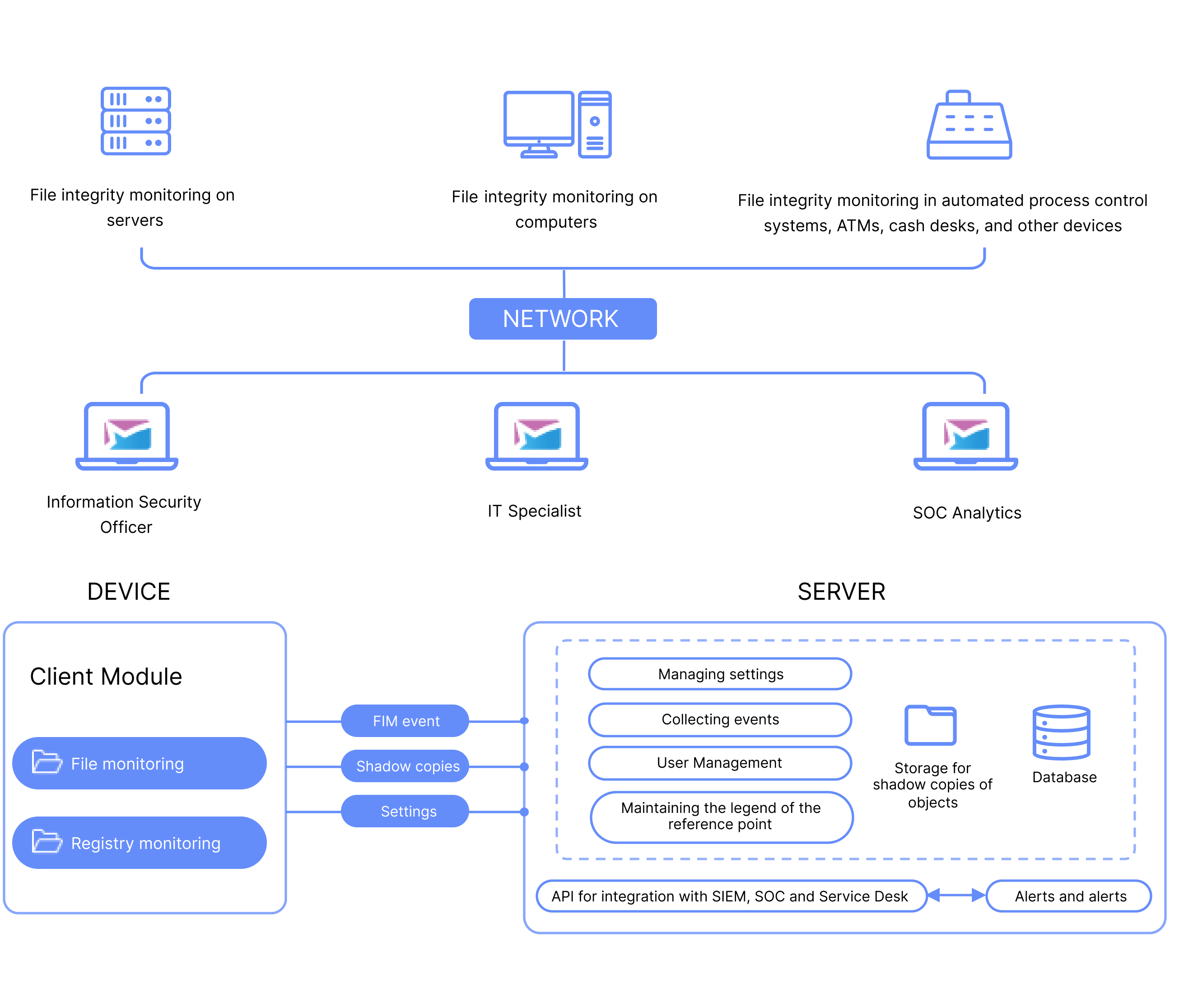
The solution consists of client modules anda management server.
The client module is installed on a device: a server, a workstation, or a specialized device (KKM, selfservice device) and monitors the status of files and registry keys in accordance with the specified policies.
The server manages settings, groups devices, collects event data from all client modules, and maintains a reporting point. You can access the server from the management console.
The intuitive and simple interface allows information security officers, IT department and SOC analysts to use monitoring.
The solution can be integrated with SIEM, SOC, and Service Desk to create a unified workflow and reduce employee workload.

 Technical Support